Wellness, Auto-Immune Disease, Anti-Aging, Gut
How the Gut Microbiome is Critical for Energy and Proper Digestion
Are you just sick of suffering from low energy, brain fog, and all the embarrassing gut issues that so many of us are plagued with? Let me tell you today about how your gut microbiome is one of your body’s best friends.

By helping with digestion and vitamin synthesis, a healthy microbiome will support your body’s energy needs, help your gut behave like it is supposed to, and allow for healthy brain function (including your overall mood and ability to think clearly).
This complex community of trillions of microorganisms primarily hangs out in your digestive tract, and it plays an essential role in maintaining your health. Some of its critical functions include helping with the digestion of food and the absorption of vital nutrients. Without your gut microbiome, your ability to process certain foods and extract vital nutrients would be severely impaired. Today, we will explore how your friendly bacteria contribute to your healthy digestion.
The Role of Your Gut Microbiome in Digestion
When we talk about digestion, we are talking about the process of breaking down food into smaller particles that can be absorbed into the bloodstream and used by the cells for complex metabolic processes. Your body has enzymes that handle a lot of the initial breakdown of carbohydrates, proteins, and fats. However, your gut microbiome is needed to process complex carbohydrates, fibers, and other compounds the enzymes cannot digest on their own.
Fermentation of Complex Carbohydrates and Fibers
Many of the carbohydrates and fibers in your diet are indigestible by your body’s digestive enzymes. For example:
- Cellulose - found in root and leafy vegetables, legumes, and some fruits such as pears and apples.
- Resistant starches - found in nuts, seeds, beans, legumes, whole grains, unripe bananas and plantains.
- Oligosaccharides - found in onions, garlic, beans/lentils and many wheat products. Side note: a sensitivity to oligosaccharides may help explain some cases of non-celiac gluten sensitivity.
Instead of being digested by your enzymes, they pass into the large intestine where the gut microbiome goes to work fermenting these complex carbohydrates and breaking them down into simpler compounds like short chain fatty acids (SCFAs).
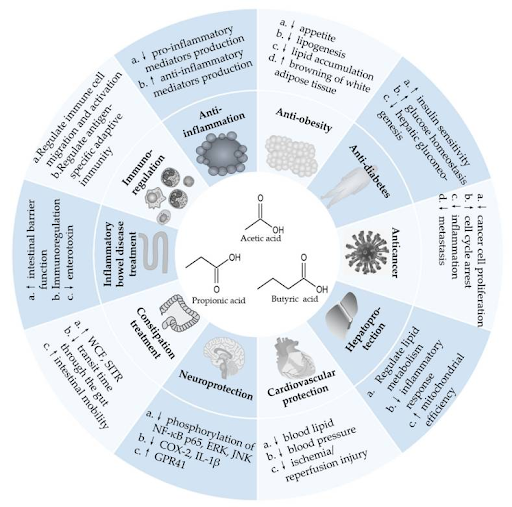
One of the primary products of microbial fermentation are SCFAs like acetate, propionate, and butyrate. These SCFAs are critical to your health. For example, Butyrate is a preferred energy source for the cells in the colon, called colonocytes. It also plays a role in maintaining gut integrity, healing a leaky gut, and reducing inflammation.
What else do SCFAs do?
- Reduce your risk of obesity, diabetes, inflammation, cancer, bowel disease
- Protect your liver, brain, heart and vascular system
- Helps maintain the integrity of your gut barrier, preventing infection and tissue injury
- Regulates your immune system, lipid metabolism, and bowel habits
- Helps to lower your blood pressure and cholesterol
The fermentation provided by these bacteria also helps your body extract additional calories from your food that would otherwise be inaccessible. This process can contribute significantly to your overall ability to produce energy from your food, especially in high fiber diets. I am of the opinion that is why so many people are doing so well on the carnivore diet because they lack these important friendly bacteria.
Protein Metabolism
The gut microbiome also contributes to the metabolism of proteins in your food. There are undigested proteins that reach the large intestine and have not yet been broken down by the stomach and small intestine. Once they arrive in the large intestine, the friendly bacteria further metabolize these proteins. This process produces various metabolites like polyamines which have been shown to have an antioxidant effect and influence the mucosal barrier of the intestines.
Certain gut bacteria can also synthesize essential amino acids, which are then absorbed by your body. This is particularly important when you are not taking in enough amino acids through your diet.
The Role of Your Gut Microbiome in Nutrient Absorption
After digestion, your gut microbiome supports the absorption of nutrients into the bloodstream to make sure your body can use these nutrients effectively in several ways:
-
Vitamin Synthesis:
- Gut bacteria synthesize vitamin K2, which is crucial for blood clotting and bone health.
- They also synthesize various B vitamins, including biotin (B7), folate (B9), and cobalamin (B12). These are vital for energy metabolism, DNA synthesis, and your brain and nerve health.
-
Enhancing Mineral Absorption:
- SCFAs produced by bacterial fermentation can lower the pH of the colon. This enhances the solubility and absorption of calcium and magnesium.
- Meanwhile, some gut bacteria can reduce ferric iron (Fe3+) to the more absorbable ferrous form (Fe2+), which helps facilitate its absorption into your body through the intestine.
- Maintaining Gut Integrity for Optimal Absorption: A healthy and balanced gut microbiome also helps to maintain the integrity of the gut barrier. This is essential for proper absorption of nutrients. As mentioned, Butyrate (one of the SCFAs produced by the gut microbiome) plays a pivotal role in maintaining the gut barrier by promoting the formation of tight junctions between epithelial cells in the large intestine. This helps prevent the dreaded “leaky gut.”
Conclusion
The gut microbiome is your indispensable partner in the digestion of food and the absorption of nutrients. From breaking down complex carbohydrates and fibers to synthesizing essential vitamins and enhancing mineral absorption, these friendly microorganisms in your gut play a vital role in ensuring that your body has the nutrients you need for good health and energy. Maintaining a healthy gut microbiome enhances all areas of your health from your cells to your organs, to your whole body.
Since everyone’s gut is different, it can be tough to figure out what is causing your gut issues. I would love to help you discover what is blocking you from enjoying optimal health. Anyone who schedules in the next 48 hours, I am offering a FREE Root Cause Health Assessment. This is where you will fill out a detailed questionnaire, and I will review it with you personally via Zoom. That way we can personalize it based on your struggles, I will help you to discover the next right steps to take to improve your health.
Take advantage of that today by clicking here:
References
Bendtsen, L. Q., Haugaard, L., Kramer Larsen, T. M., & Holst, J. J. (2015). Effect of fermented milk products and milk proteins on appetite, energy intake, and glycemic response in humans: a systematic review and meta-analysis of randomized controlled trials. Journal of Nutrition and Metabolism, 2015, 548436. https://doi.org/10.1155/2015/548436
den Besten, G., van Eunen, K., Groen, A. K., Venema, K., Reijngoud, D. J., & Bakker, B. M. (2013). The role of short-chain fatty acids in the interplay between diet, gut microbiota, and host energy metabolism. Journal of Lipid Research, 54(9), 2325-2340. https://doi.org/10.1194/jlr.R036012
Flint, H. J., Duncan, S. H., Scott, K. P., & Louis, P. (2012). Links between diet, gut microbiota composition and gut metabolism. Proceedings of the Nutrition Society, 74(1), 13-22. https://doi.org/10.1017/S0029665114001463
Krause, A., Schlüter, R., Bock, A., & Ott, M. (2011). Bacterial factors involved in iron acquisition and utilization. Microbial Biotechnology, 4(3), 278-288. https://doi.org/10.1111/j.1751-7915.2010.00191.x
LeBlanc, J. G., Milani, C., de Giori, G. S., Sesma, F., Van Sinderen, D., & Ventura, M. (2013). Bacteria as vitamin suppliers to their host: a gut microbiota perspective. Current Opinion in Biotechnology, 24(2), 160-168. https://doi.org/10.1016/j.copbio.2012.08.005
Metges, C. C. (2000). Contribution of microbial amino acids to amino acid homeostasis of the host. The Journal of Nutrition, 130(7), 1857S-1864S. https://doi.org/10.1093/jn/130.7.1857S
Peng, L., Li, Z. R., Green, R. S., Holzman, I. R., & Lin, J. (2009). Butyrate enhances the intestinal barrier by facilitating tight junction assembly via activation of AMP-activated protein kinase in Caco-2 cell monolayers. Journal of Nutrition, 139(9), 1619-1625. https://doi.org/10.3945/jn.109.104638
Rahman, S. (2023). Gut microbial metabolites and its impact on human health. Annals of Gastroenterology. https://doi.org/10.20524/aog.2023.0809
Vermeer, C., & Schurgers, L. J. (2000). A comprehensive review of vitamin K and vitamin K antagonists. Hemostasis and Thrombosis: Basic Principles and Clinical Practice, 5th Edition, 837-860.
Windey, K., De Preter, V., & Verbeke, K. (2012). Relevance of protein fermentation to gut health. Molecular Nutrition & Food Research, 56(1), 114-126. https://doi.org/10.1002/mnfr.201100542
© Jackpot Wellness. All Rights Reserved.