Wellness, Auto-Immune Disease, Anti-Aging, Gut
How to Find Out if Your Own Immune System is Attacking Your Thyroid!!
How do you know if your thyroid issues are being caused by an Autoimmune Disease where your immune system is attacking your thyroid? That is what we are going to learn about today.
Did you know that Autoimmune Thyroid Diseases (AITD) are the most prevalent, organ-specific autoimmune diseases? Hashimoto’s Thyroiditis and Grave’s Diseases are the major causes of thyroid disease, and both are caused as a result of the body’s immune system attacking the thyroid. There are also other autoimmune diseases that attack the thyroid, and you will learn here how to identify if your thyroid is sick because of an autoimmune disease. That means the thyroid is sick because your body’s immune system is attacking and actually destroying the body’s own thyroid.
Antibodies are protective proteins produced by your immune system that circulate in the blood. They allow the body’s immune system to recognize an enemy invading the body. These enemies come as bacteria, viruses, fungus, mold, and so on. These antibodies are supposed to attach to FOREIGN substances (antigens) in order to REMOVE them from your body. We rely on this part of our immune system to keep us safe from these microscopic invaders. However, when the immune system gets confused and forms antibodies against healthy tissues, it can literally start attacking YOUR ACTUAL BODY!
What is worse is if the immune system is attacking one organ (like the thyroid), there is a good chance it is attacking other organs as well. If it isn’t already attacking other organs, then it will most likely start attacking other organs and tissues in the future if the immune system is not corrected.
Checking if the body is producing antibodies against the thyroid can give critical insight into what is happening with the immune system in general as well as give you the information you need regarding the cause of your thyroid disease.
Which lab tests tell you if your body has produced antibodies that are attacking the thyroid?
- Thyroid Peroxidase Antibody (TPOAb)
- Thyroglobulin Antibody (TgAb), aka Thyroid Antithyroglobulin Antibody (TAA)
- Thyroid Stimulating Receptor Antibody (TRAb)
Optimally, all of these antibody tests should be at zero in the lab test. This would reflect that no antibodies are being formed against these healthy thyroid tissues.
The Thyroid Peroxidase Antibody (TPOAb) test shows if the body is attacking its own thyroid peroxidase (TPO). Thyroid peroxidase is an enzyme that plays a critical role in oxidizing iodine atoms within thyroglobulin.
The Thyroglobulin Antibody (TG Ab) test shows if the body is attacking its own thyroglobulin, which is a large glycoprotein produced by the thyroid gland. Thyroglobulin facilitates the TPO to perform iodination of the iodine atoms and serves as a scaffold for the synthesis of thyroid hormones. Both the thyroglobulin and thyroid peroxidase are critical to the iodine processes needed to produce thyroid hormone.
The Thyroid Stimulating Receptor Antibody (TRAb) test shows if the body is attacking the TSH Receptors that bind TSH to the thyroid which stimulates thyroid hormone synthesis and release of thyroid hormones into the bloodstream. Generally this is tested for hyperthyroid patients to see if the Autoimmune Disease, Grave’s Disease is present.
Checking if the body is producing antibodies against any of these healthy tissues helps to determine if the thyroid malfunction is being caused by an autoimmune issue vs a different reason. Our ability to correct the problems of the thyroid lies in knowing why the problem exists to begin with.
If one of these antibody tests is elevated, you can assume there is an autoimmune process occurring that is leading to inflammation of the thyroid. It is not uncommon for the thyroid to be the first organ under attack for many people, so checking this early can help head off a lot of future issues.
Once the thyroid is under attack, it will become inflamed. Inflammation of the thyroid will disrupt normal thyroid function.
Graph explaining elevated antibody tests:
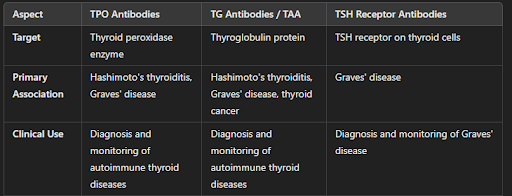
Other Autoimmune Diseases: These elevated antibodies (TPOAb, TGAb, and TRAb) are also associated with other autoimmune conditions such as type 1 diabetes, rheumatoid arthritis, lupus, and postpartum thyroiditis.
When the immune system is busy going after your healthy tissues, three major problems occur:
- Chronic inflammation inside the body runs rampant which drives all chronic disease processes.
- Real infections lurking in the body go unchecked and are allowed to wreak havoc.
- The immune system neglects its job of clearing out the old and defective cells that can later morph into cancer cells. Cancer often develops many years after someone has been suffering from diagnosed or undiagnosed autoimmune disease. I know this fact all too well, as it is what happened to me.
You see why it is so important to check for these antibodies in your blood, especially if you have known thyroid disease or known autoimmune disease? The presence of these antibodies not only can tell you more about your thyroid issue, but it can also give insight into other possible autoimmune diseases occurring within your body. Antibodies that don’t belong in the immune system provide a barometer of the health of your immune system itself. There are over 80 different autoimmune diseases that have been identified, some common autoimmune diseases you may be familiar with are things like:
- Multiple sclerosis
- Myasthenia Gravis
- Rheumatoid Arthritis
- Lupus
- Type 1 Diabetes
- Celiac Disease
-
Inflammatory Bowel Disease
- Crohn’s Disease
- Ulcerative Colitis
What causes the immune system to start attacking healthy cells? The same things that make the thyroid sick that we discussed in previous videos. Things like:
-
Environmental toxins
- “Cides” (herbicides, pesticides, fungicides, and the like)
- Air and water pollution
- Radiation
- Heavy metal toxicity
- Exposure to cigarette smoke
- Fragrance in beauty or household products
- So on…
- Hormone disruption
- Nutrition deficiencies
- Stress and psychological challenges
-
Chronic infections
- Parasites
- Bacteria
- Viruses
- Fungus
- Mold
- Other infections
Once you remove the reasons your body has for immune system misfire, your body can begin the healing process. You can literally turn on and off how certain genes express themselves through epigenetics by changing many of these factors through lifestyle. Other things, like chronic infections and build up of heavy metals and toxins may need to be dealt with through supplements to help pull out these toxins out and kill infections that are going unnoticed by your immune system.
I hope you can see the real value in figuring out if your body is attacking itself. This helps to bring clarity around other autoimmune issues you may be suffering from or at risk of developing. By knowing this information, you can start taking steps to provide the things your body is asking for as well as avoid the things that are causing this immune system misfire so your body can begin to heal.
This is not an exhaustive list of every single thyroid blood test that can be checked, but these tests will definitely help you determine if you have thyroid disease, and if it is thyroid disease that is causing your symptoms. It will also help you figure out if Autoimmune Disease is the driving force of YOUR thyroid problems. Armed with this knowledge, you can go about the business of getting your body healed.
Over the coming weeks, we are going to tie all this information together, answer the questions I have received that I have not already answered in the series, tell you what you can do, and I will be making a special offer to work with me directly for just a handful of people, so stay tuned for that. I only have a few spots available.
It is so exciting for me to teach this to you! I am on a mission to help others have the chance to heal their body before their health deteriorates. I wish someone had taught me this information 30 years ago before I even knew I had thyroid problems. I know I had thyroid problems years before I was diagnosed because I suffered with all the symptoms for years. I was diagnosed and treated for anxiety and depression, told I was “Being Drama,” and brushed aside for years when I complained of severe fatigue, inability to get going during the day, and just feeling totally hopeless and drained physically. No one took me seriously. They just saw what appeared to be a healthy young woman in front of them making a big deal out of nothing. Now, thirty years later, I feel better than I ever have. That is why I take YOU seriously when you share with me the symptoms that YOU are suffering with.
I am here to tell you, this does not have to be your destiny. It is never too late to start healing your body, but the earlier you start, the earlier your body can course correct and get on the road to health.
I would love to hear back from you if you have any questions and to hear if this information is helping you to better understand your own thyroid.
Also, reach out to me if you want to apply to work with me for personalized protocols to help optimize your health.
Feel free to check back on the previous videos in the series here.
Find the extensive list of symptoms in this document hand out here: Common Signs and Symptoms of Hyper and Hypothyroidism.
References
American Thyroid Association . (2019). Thyroid Function Tests | American Thyroid Association. Retrieved from American Thyroid Association website: https://www.thyroid.org/thyroid-function-tests/
ANDRA, S. S., & MAKRIS, K. C. (2012). Thyroid Disrupting Chemicals in Plastic Additives and Thyroid Health. Journal of Environmental Science and Health, Part C, 30(2), 107–151. https://doi.org/10.1080/10590501.2012.681487
Armstrong, M., Asuka, E., & Fingeret, A. (2023). Physiology, Thyroid Function. Retrieved from PubMed website: https://www.ncbi.nlm.nih.gov/books/NBK537039/#:~:text=T4 is converted to T3
Atmaca, H., Tanriverdi, F., Gokce, C., Unluhizarci, K., & Kelestimur, F. (2007). Do We Still Need the TRH Stimulation Test? Thyroid, 17(6), 529–533. https://doi.org/10.1089/thy.2006.0311
Bacciottini, L., Falchetti, A., Pampaloni, B., Bartolini, E., Carossino, A. M., & Brandi, M. L. (2007). Phytoestrogens: food or drug? Clinical Cases in Mineral and Bone Metabolism, 4(2), 123–130. Retrieved from https://www.ncbi.nlm.nih.gov/pmc/articles/PMC2781234/
Dasari, S., Naha, K., Hande, M., & Vivek, G. (2014). Hot and cold: coexistent Graves’ disease and Hashimoto’s thyroiditis in a patient with Schmidt’s syndrome. Case Reports, 2014(may21 2), bcr2013010432–bcr2013010432. https://doi.org/10.1136/bcr-2013-010432
Dong, B. J. (2000). How medications affect thyroid function. Western Journal of Medicine, 172(2), 102–106. Retrieved from https://www.ncbi.nlm.nih.gov/pmc/articles/PMC1070767/
Haugen, B. R., Alexander, E. K., Bible, K. C., Doherty, G. M., Mandel, S. J., Nikiforov, Y. E., … Wartofsky, L. (2016). 2015 American Thyroid Association Management Guidelines for Adult Patients with Thyroid Nodules and Differentiated Thyroid Cancer: The American Thyroid Association Guidelines Task Force on Thyroid Nodules and Differentiated Thyroid Cancer. Thyroid : Official Journal of the American Thyroid Association, 26(1), 1–133. https://doi.org/10.1089/thy.2015.0020
Mohamedali, M., Reddy Maddika, S., Vyas, A., Iyer, V., & Cheriyath, P. (2014). Thyroid Disorders and Chronic Kidney Disease. International Journal of Nephrology, 2014. https://doi.org/10.1155/2014/520281
Moura Neto, A., & Zantut-Wittmann, D. E. (2016). Abnormalities of Thyroid Hormone Metabolism during Systemic Illness: The Low T3 Syndrome in Different Clinical Settings. International Journal of Endocrinology, 2016, 1–9. https://doi.org/10.1155/2016/2157583
National Institute of Environmental Health Sciences. (2024, February 6). Endocrine Disruptors. Retrieved from National Institute of Environmental Health Sciences website: https://www.niehs.nih.gov/health/topics/agents/endocrine
Pirahanchi, Y., Jialal, I., & Toro, F. (2023). Physiology, Thyroid Stimulating Hormone (TSH). Retrieved from Nih.gov website: https://www.ncbi.nlm.nih.gov/books/NBK499850/
Pirahanchi, Y., Toro, F., & Jialal, I. (2023). Physiology, Thyroid Stimulating Hormone. Retrieved from PubMed website: https://pubmed.ncbi.nlm.nih.gov/29763025/#:~:text=The hypothalamic%2Dpituitary axis regulates
Sara Ellegaard Christensen, Liv Norma Smith, Alexander, C., Helga Angela Gulisano, Kåre Schmidt Ettrup, Vestergaard, P., … Dal, J. (2023). The TRH test provides valuable information in the diagnosis of central hypothyroidism in patients with known pituitary disease and low T4 levels. Frontiers in Endocrinology, 14. https://doi.org/10.3389/fendo.2023.1226887
Selwan Khamisi, Lundqvist, M., Britt Edén Engström, Larsson, A., F Anders Karlsson, & Ljunggren, Ö. (2023). Comparison Between Thyroid Stimulating Immunoglobulin and TSH-Receptor Antibodies in the Management of Graves’ Orbitopathy. https://doi.org/10.1055/a-2021-0596
Shahid, M. A., Ashraf, M. A., & Sharma, S. (2020). Physiology, Thyroid Hormone. Retrieved from PubMed website: https://www.ncbi.nlm.nih.gov/books/NBK500006/#:~:text=Regulation of thyroid hormone starts
T3 Uptake | Rupa Health. (2020). Retrieved August 19, 2024, from Rupa Health website: https://www.rupahealth.com/biomarkers/t3-uptake#:~:text=The clinical significance of T3
Thyroid antibodies explained. (2022, February 15). Retrieved from British Thyroid Foundation website: https://www.btf-thyroid.org/thyroid-antibodies-explained#:~:text=Thyroid stimulating hormone receptor antibodie
© Jackpot Wellness. All Rights Reserved.