Wellness, Auto-Immune Disease, Anti-Aging, Gut
How Thyroid Hormones Communicate Between the Hypothalamus, Pituitary, and Thyroid Glands
In this video, I will give a simplified explanation of how the thyroid works and how the other organs in the brain help it work. This knowledge will support you in understanding how your thyroid knows the right amount of hormone to produce in a healthy body.
You won’t be a thyroid expert at the end of this series, but you will definitely be able to look at your thyroid bloodwork and understand a lot about your thyroid function as well as some other body functions.
The body relies on three structures in the hypothalamus-pituitary-thyroid axis to produce thyroid hormones and to know how much hormone to send into the body:
- The hypothalamus - found in the brain
- The anterior pituitary gland - found in the brain
- The thyroid gland - a butterfly-shaped gland located in the front of the neck.
We will start with learning what the normal process looks like before we dive into learning about abnormal findings.
In a nutshell
Hypothalamus & Pituitary
The hypothalamus produces a hormone called thyrotropin-releasing hormone, aka, thyroid releasing hormone, or TRH.
TRH communicates with the anterior pituitary gland (just below the hypothalamus). TRH tells the anterior pituitary gland to release the thyroid-stimulating hormone (TSH). The amount of TSH released depends on the circulating levels of thyroid hormones detected in the blood.
Thyroid
Inside the thyroid, the following are stored:
-
Thyroglobulin (TG)
- A precursor protein that stores iodine needed to make thyroid hormone.
- Stores and releases thyroid hormones into the bloodstream.
- Thyroid peroxidase (TPO) - A thyroid enzyme that accelerates the oxidation of iodide to form iodine atoms that are needed to create the thyroid hormones your body uses.
- Thyroxine (aka tetraiodothyronine or T4). This is the primary thyroid hormone. Think of it as stored thyroid hormone.
- Triiodothyronine (aka T3) - This is the thyroid hormone that is usable by the body. This is made from T4. Once made, it is only usable by the cells for a few hours, so the body is constantly making more of it from the hormone T4 by breaking off an iodine molecule.
I want to break down the words tetraiodothyronine and triiodothyronine because that can be useful in making sense of the process:
- Tetra = 4 - referring to # of iodine molecules
- Tri = 3 - referring to # of iodine molecules
- Iodo = iodine molecules
- Thyronine = name for thyroid hormone.
Tetraiodothyronine (T4) = thyroid hormone with 4 iodine molecules - stored thyroid hormone.
Triiodothyronine (T3) = thyroid hormone with 3 iodine molecules - usable thyroid hormone made from T4 by removing one iodine molecule.
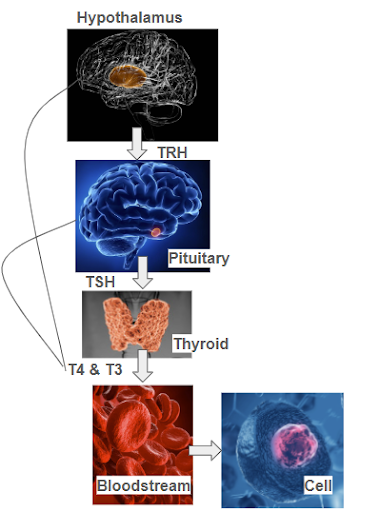
Why does this all matter? Thyroid hormones are critical to many body processes. Every cell in the body needs thyroid hormone in order to work properly. Thyroid hormone is involved with:
- Regulating weight and various metabolism functions
- Energy levels
- Body temperature
- Brain function
- Skin/hair/nail health
- Growth in children
- Heart function
- Skeletal and muscle function
- Digestive health
- Bone maintenance
- Thyroid hormones affect the balance of other hormones like testosterone, estrogen, and progesterone
- More
How well the thyroid is working influences how well all your cells in your body are working and your overall health.
References
American Thyroid Association . (2019). Thyroid Function Tests | American Thyroid Association. Retrieved from American Thyroid Association website: https://www.thyroid.org/thyroid-function-tests/
ANDRA, S. S., & MAKRIS, K. C. (2012). Thyroid Disrupting Chemicals in Plastic Additives and Thyroid Health. Journal of Environmental Science and Health, Part C, 30(2), 107–151. https://doi.org/10.1080/10590501.2012.681487
Armstrong, M., Asuka, E., & Fingeret, A. (2023). Physiology, Thyroid Function. Retrieved from PubMed website: https://www.ncbi.nlm.nih.gov/books/NBK537039/#:~:text=T4 is converted to T3
Atmaca, H., Tanriverdi, F., Gokce, C., Unluhizarci, K., & Kelestimur, F. (2007). Do We Still Need the TRH Stimulation Test? Thyroid, 17(6), 529–533. https://doi.org/10.1089/thy.2006.0311
Bacciottini, L., Falchetti, A., Pampaloni, B., Bartolini, E., Carossino, A. M., & Brandi, M. L. (2007). Phytoestrogens: food or drug? Clinical Cases in Mineral and Bone Metabolism, 4(2), 123–130. Retrieved from https://www.ncbi.nlm.nih.gov/pmc/articles/PMC2781234/
Dasari, S., Naha, K., Hande, M., & Vivek, G. (2014). Hot and cold: coexistent Graves’ disease and Hashimoto’s thyroiditis in a patient with Schmidt’s syndrome. Case Reports, 2014(may21 2), bcr2013010432–bcr2013010432. https://doi.org/10.1136/bcr-2013-010432
Dong, B. J. (2000). How medications affect thyroid function. Western Journal of Medicine, 172(2), 102–106. Retrieved from https://www.ncbi.nlm.nih.gov/pmc/articles/PMC1070767/
Haugen, B. R., Alexander, E. K., Bible, K. C., Doherty, G. M., Mandel, S. J., Nikiforov, Y. E., … Wartofsky, L. (2016). 2015 American Thyroid Association Management Guidelines for Adult Patients with Thyroid Nodules and Differentiated Thyroid Cancer: The American Thyroid Association Guidelines Task Force on Thyroid Nodules and Differentiated Thyroid Cancer. Thyroid : Official Journal of the American Thyroid Association, 26(1), 1–133. https://doi.org/10.1089/thy.2015.0020
Mohamedali, M., Reddy Maddika, S., Vyas, A., Iyer, V., & Cheriyath, P. (2014). Thyroid Disorders and Chronic Kidney Disease. International Journal of Nephrology, 2014. https://doi.org/10.1155/2014/520281
Moura Neto, A., & Zantut-Wittmann, D. E. (2016). Abnormalities of Thyroid Hormone Metabolism during Systemic Illness: The Low T3 Syndrome in Different Clinical Settings. International Journal of Endocrinology, 2016, 1–9. https://doi.org/10.1155/2016/2157583
National Institute of Environmental Health Sciences. (2024, February 6). Endocrine Disruptors. Retrieved from National Institute of Environmental Health Sciences website: https://www.niehs.nih.gov/health/topics/agents/endocrine
Pirahanchi, Y., Jialal, I., & Toro, F. (2023). Physiology, Thyroid Stimulating Hormone (TSH). Retrieved from Nih.gov website: https://www.ncbi.nlm.nih.gov/books/NBK499850/
Pirahanchi, Y., Toro, F., & Jialal, I. (2023). Physiology, Thyroid Stimulating Hormone. Retrieved from PubMed website: https://pubmed.ncbi.nlm.nih.gov/29763025/#:~:text=The hypothalamic%2Dpituitary axis regulates
Sara Ellegaard Christensen, Liv Norma Smith, Alexander, C., Helga Angela Gulisano, Kåre Schmidt Ettrup, Vestergaard, P., … Dal, J. (2023). The TRH test provides valuable information in the diagnosis of central hypothyroidism in patients with known pituitary disease and low T4 levels. Frontiers in Endocrinology, 14. https://doi.org/10.3389/fendo.2023.1226887
Selwan Khamisi, Lundqvist, M., Britt Edén Engström, Larsson, A., F Anders Karlsson, & Ljunggren, Ö. (2023). Comparison Between Thyroid Stimulating Immunoglobulin and TSH-Receptor Antibodies in the Management of Graves’ Orbitopathy. https://doi.org/10.1055/a-2021-0596
Shahid, M. A., Ashraf, M. A., & Sharma, S. (2020). Physiology, Thyroid Hormone. Retrieved from PubMed website: https://www.ncbi.nlm.nih.gov/books/NBK500006/#:~:text=Regulation of thyroid hormone starts
T3 Uptake | Rupa Health. (2020). Retrieved August 19, 2024, from Rupa Health website: https://www.rupahealth.com/biomarkers/t3-uptake#:~:text=The clinical significance of T3
Thyroid antibodies explained. (2022, February 15). Retrieved from British Thyroid Foundation website: https://www.btf-thyroid.org/thyroid-antibodies-explained#:~:text=Thyroid stimulating hormone receptor antibodie
© Jackpot Wellness. All Rights Reserved.