Wellness, Auto-Immune Disease, Anti-Aging, Gut
Your Thyroid is A Warning System for Your WHOLE Body!
When the thyroid is under attack, think of it as your thermostat to your house that keeps everything at the right temperature. If the thyroid is out of whack, everything is out of whack. Your thyroid regulates:
- Your metabolism and how you burn calories
- How fast your heart beats
- How other hormones are working in the body
- Your adrenal system
- Your digestive system: the pancreas, bowels, liver are all affected
- Muscle and bone maintenance
- Brain and nervous system development and function
- Even how your body is functioning at the cellular level.
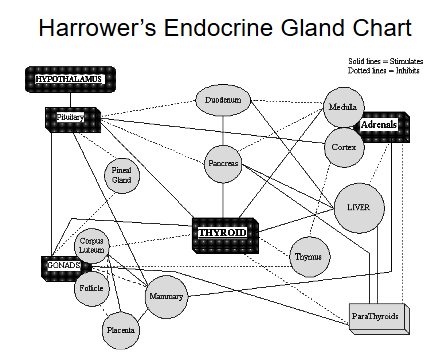
The Harrower’s Endocrine Gland Chart gives a glimpse into the powerhouse of an endocrine gland that your thyroid is. I don’t expect you to memorize this chart. I just want to highlight how involved your thyroid is in all of your endocrine functions.
Whether the thyroid is pumping out too much hormone (hyperthyroid) or too little hormone (hypothyroid), often boils down to an autoimmune issue attacking the thyroid. These conditions are usually called Grave’s Disease or Hashimoto’s thyroiditis. Foundationally, the immune system misfire starts in the gut.
The traditional medicine approach is to treat the hormone imbalance. This is done by either replacing the thyroid hormone if it is too low or by giving medication to damage the thyroid so it stops spitting out too much thyroid hormone if there is too much. This ultimately leads to damage of the thyroid gland and usually results in a low functioning thyroid…eventually.
The problem with this approach is that it really only addresses the SYMPTOMS of the thyroid being under attack, but it does nothing for settling down the immune system misfire or repairing the gut. While medication is a CRITICAL step in helping you recover (so don’t skip medication if you need it), it doesn’t get to the root of the cause.
Think of taking medication for your thyroid like solving the problem of a puddle on your floor by simply mopping up the floor. You ABSOLUTELY need to mop up the floor to prevent damage to the floor.
However, you also want to discover where the water is coming from? If the water on the floor is coming from a water leak in the plumbing, then just mopping the floor alone will not solve the root cause issue. If the plumbing problem is left to continue leaking, then it will eventually grow mold, it can rot the wood, do additional damage to the structure, and result in a much bigger issue than a simple plumbing leak or puddle on the floor.
The body works the same way. One area not working properly affects other areas of the body. Likewise, one area not working properly alerts you to other areas that may also not be working properly. Think of the thyroid problem as the floor with water on it, the gut issue as the plumbing problem, and the immune system misfiring as damage being done to the structure that can result in mold growing (or other infections) being allowed to go unchecked by the immune system.
What causes the original issue in the gut to get off track? Let’s go back to the plumbing analogy. It could be because of wear and tear over time. Compare this to constant exposure to a food the gut is sensitive to or infection that the body doesn’t fully clear out which allows it to do damage to the gut over time.
It could also be caused by a major event, like a tree root breaking the plumbing or a pipe just bursting open.
For the body, this could be a major emotional or physical trauma. Usually it is a combination of more than one thing.
Whatever the cause, it is critical to repair the plumbing (or the gut) before there is more damage done.
When looking to repair the thyroid and stop your immune system from attacking your body, we always want to start with the gut. If the gut is leaky, which we can basically guarantee is going on with any Autoimmune Disease, we must first fix the gut. That will solve a large number of autoimmune issues, including thyroid problems.
You see, the gut lining is designed to be a protective barrier for the inside of your body from the outside pathogens that are brought into our body through what we eat and drink. When the gut is working properly, it is designed to only let the good stuff in the bloodstream, like healthy fats and proteins, vitamins, and minerals. Meanwhile, it is supposed to keep the bad stuff out. All the bad stuff is supposed to be eliminated through pooping.
There are other ways the body removes toxins:
- Cleaning the blood with the kidneys and urinating it out
- Exhaling through our lungs
- Sweating it out of our skin
Of course, the liver is highly involved in removing toxins and putting it into the gut to be eliminated when we poop. The gut really comes in contact with some of the most damaging toxins. When the gut becomes inflamed, then it gets leaky. A leaky gut lining allows the bad stuff to get into the blood causing the immune system to be overworked and overly active trying to go after all the stuff that doesn’t belong there.
What causes a leaky gut?
There is so much more to share about the gut, and I would love to make some videos about the gut, but this wraps up the series on how you can interpret your own thyroid labs. If you want me to share more about how the leaky gut leads to autoimmune disease and thyroid issues, reply to this email the word “Gut,” and I will be happy to make a video for you about that.
Key Takeaway Points About Thyroid Labs:
- TSH high, this is a signal that your body NEEDS MORE thyroid hormone
- TSH low, this is a signal that your body may have TOO MUCH thyroid hormone
- T4 - is the stored hormone
- T3 - is the usable hormone made from T4
- Reverse T3 - is a mirrored version of T3 that can clog up the cells preventing the T3 from getting into the cells to be used.
- TPO Ab, TG Ab, TSH Receptor Ab - indications that the immune system is attacking the thyroid, and you have an autoimmune problem.
Feel free to check back on the previous videos in the series here.
Find the extensive list of symptoms in this document hand out here: Common Signs and Symptoms of Hyper and Hypothyroidism.
References
American Thyroid Association . (2019). Thyroid Function Tests | American Thyroid Association. Retrieved from American Thyroid Association website: https://www.thyroid.org/thyroid-function-tests/
ANDRA, S. S., & MAKRIS, K. C. (2012). Thyroid Disrupting Chemicals in Plastic Additives and Thyroid Health. Journal of Environmental Science and Health, Part C, 30(2), 107–151. https://doi.org/10.1080/10590501.2012.681487
Armstrong, M., Asuka, E., & Fingeret, A. (2023). Physiology, Thyroid Function. Retrieved from PubMed website: https://www.ncbi.nlm.nih.gov/books/NBK537039/#:~:text=T4 is converted to T3
Atmaca, H., Tanriverdi, F., Gokce, C., Unluhizarci, K., & Kelestimur, F. (2007). Do We Still Need the TRH Stimulation Test? Thyroid, 17(6), 529–533. https://doi.org/10.1089/thy.2006.0311
Bacciottini, L., Falchetti, A., Pampaloni, B., Bartolini, E., Carossino, A. M., & Brandi, M. L. (2007). Phytoestrogens: food or drug? Clinical Cases in Mineral and Bone Metabolism, 4(2), 123–130. Retrieved from https://www.ncbi.nlm.nih.gov/pmc/articles/PMC2781234/
Dasari, S., Naha, K., Hande, M., & Vivek, G. (2014). Hot and cold: coexistent Graves’ disease and Hashimoto’s thyroiditis in a patient with Schmidt’s syndrome. Case Reports, 2014(may21 2), bcr2013010432–bcr2013010432. https://doi.org/10.1136/bcr-2013-010432
Dong, B. J. (2000). How medications affect thyroid function. Western Journal of Medicine, 172(2), 102–106. Retrieved from https://www.ncbi.nlm.nih.gov/pmc/articles/PMC1070767/
Haugen, B. R., Alexander, E. K., Bible, K. C., Doherty, G. M., Mandel, S. J., Nikiforov, Y. E., … Wartofsky, L. (2016). 2015 American Thyroid Association Management Guidelines for Adult Patients with Thyroid Nodules and Differentiated Thyroid Cancer: The American Thyroid Association Guidelines Task Force on Thyroid Nodules and Differentiated Thyroid Cancer. Thyroid : Official Journal of the American Thyroid Association, 26(1), 1–133. https://doi.org/10.1089/thy.2015.0020
Mohamedali, M., Reddy Maddika, S., Vyas, A., Iyer, V., & Cheriyath, P. (2014). Thyroid Disorders and Chronic Kidney Disease. International Journal of Nephrology, 2014. https://doi.org/10.1155/2014/520281
Moura Neto, A., & Zantut-Wittmann, D. E. (2016). Abnormalities of Thyroid Hormone Metabolism during Systemic Illness: The Low T3 Syndrome in Different Clinical Settings. International Journal of Endocrinology, 2016, 1–9. https://doi.org/10.1155/2016/2157583
National Institute of Environmental Health Sciences. (2024, February 6). Endocrine Disruptors. Retrieved from National Institute of Environmental Health Sciences website: https://www.niehs.nih.gov/health/topics/agents/endocrine
Pirahanchi, Y., Jialal, I., & Toro, F. (2023). Physiology, Thyroid Stimulating Hormone (TSH). Retrieved from Nih.gov website: https://www.ncbi.nlm.nih.gov/books/NBK499850/
Pirahanchi, Y., Toro, F., & Jialal, I. (2023). Physiology, Thyroid Stimulating Hormone. Retrieved from PubMed website: https://pubmed.ncbi.nlm.nih.gov/29763025/#:~:text=The hypothalamic%2Dpituitary axis regulates
Sara Ellegaard Christensen, Liv Norma Smith, Alexander, C., Helga Angela Gulisano, Kåre Schmidt Ettrup, Vestergaard, P., … Dal, J. (2023). The TRH test provides valuable information in the diagnosis of central hypothyroidism in patients with known pituitary disease and low T4 levels. Frontiers in Endocrinology, 14. https://doi.org/10.3389/fendo.2023.1226887
Selwan Khamisi, Lundqvist, M., Britt Edén Engström, Larsson, A., F Anders Karlsson, & Ljunggren, Ö. (2023). Comparison Between Thyroid Stimulating Immunoglobulin and TSH-Receptor Antibodies in the Management of Graves’ Orbitopathy. https://doi.org/10.1055/a-2021-0596
Shahid, M. A., Ashraf, M. A., & Sharma, S. (2020). Physiology, Thyroid Hormone. Retrieved from PubMed website: https://www.ncbi.nlm.nih.gov/books/NBK500006/#:~:text=Regulation of thyroid hormone starts
T3 Uptake | Rupa Health. (2020). Retrieved August 19, 2024, from Rupa Health website: https://www.rupahealth.com/biomarkers/t3-uptake#:~:text=The clinical significance of T3
Thyroid antibodies explained. (2022, February 15). Retrieved from British Thyroid Foundation website: https://www.btf-thyroid.org/thyroid-antibodies-explained#:~:text=Thyroid stimulating hormone receptor antibodie
© Jackpot Wellness. All Rights Reserved.